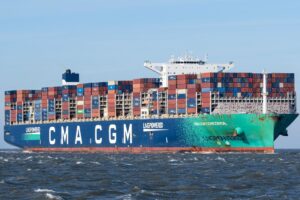

Located at the southernmost tip of Africa, South Africa is a globally significant hub for shipping activity, serving as a vital gateway to the continent and a key stop along many international shipping routes. Along these routes, South Africa connects with markets in Asia, Europe, the Americas and across Africa, supporting both local and international trade. Key industries driving South Africa’s trade are mining, agriculture, automotive manufacturing and technology products. With a wealth of key trade commodities and a significant role in global supply chains, leading shipping and logistics providers, such as CMA CGM, operate extensively across South Africa to provide reliable shipping services. For CMA CGM, its solutions are backed by extensive ocean, air and inland transportation networks, which bring together its global expertise to help connect South African businesses to the world.
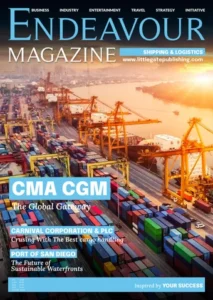
Check out the article in the magazine below:
For over 15 years, CMA CGM has been present in South Africa, providing customers with advanced global shipping solutions spanning a wide range of shipping lines. In South Africa, CMA CGM’s operations are delivered by CMA CGM Shipping Agencies South Africa (Pty) Ltd, the company’s South African agent operating under the global CMA CGM Group. Through CMA CGM South Africa’s global network, South African customers gain access to key global shipping routes that connect to destinations in Asia, the Middle East, the Indian Sub-Continent, Africa, the Mediterranean and both North and South America. These services include SHAKA, ASAF, MIDAS1, MIDAS2 and SSA, and are supported by CMA CGM’s inland logistics subsidiary, CEVA Logistics. In South Africa, CEVA Logistics works alongside CMA CGM’s fleets to offer complete door-to-door services that support customers’ supply chains from start to finish.
One of the most significant ports in South Africa, which is served by CMA CGM’s operations, is the Port of Durban, where the South African division of the company is headquartered. The Port of Durban is the fourth largest port in the Southern Hemisphere and offers 58 berths supported by a technologically advanced infrastructure to track and process the more than 30 million tons of cargo that pass through the port every year. For this reason, the port is home to a range of terminals, including one of the largest shipping terminals on the African continent, which connects to vital international shipping routes and sees the arrival of 4500 million commercial vessels every year. The port is specifically designed for container, automotive and liquid bulk operations, as well as dry bulk, break bulk and various multi-purpose cargo services. With such diverse cargo infrastructure at the Port of Durban, CMA CGM is able to offer a plethora of shipping services connecting the port to businesses across the world.
However, one of the most vital aspects of the Port’s infrastructure is its dedicated Roll-on/Roll-Off Terminal, which is operated by Transnet Port Terminals. The terminal specialises in handling wheeled cargo, ideal for automotive products including vehicles, trucks and trailers. For South Africa, the automotive market is a key aspect of its global trade, and so the dedicated terminal helps solidify the Port’s place as a hub for South Africa’s automotive sector. Therefore, CMA CGM utilises the Roll-on/Roll-off terminal to help connect the South African automotive industry to the world, offering a vital gateway into the country’s automotive market.
Another significant port for CMA CGM in South Africa is the Port of Cape Town, where the company has a local office. The port is an artificial commercial seaport strategically located in Table Bay. The Port, managed by Transnet National Ports Authority, is one of the premier ports in the Western Cape region, and offers vital port services spanning container, liquid bulk, dry bulk and break-bulk commodities. One of the most significant aspects of the port’s infrastructure is its container terminal, which recently underwent a 5.4 million rand expansion to double its capacity to now serve 1.5 million twenty equivalent units (TEUs) of cargo a year. The development saw the expansion of the container berths, which enable large container vessels to access the terminal where they are met with ship-to-shore cranes with double lift capacity.
Across the terminal, a variety of cargo is handled; however, one of the vital industries served by the terminal is the agricultural sector. The port is vital to agricultural exports due to its location close to the key agricultural hinterland. Therefore, the Port of Cape Town is a premier fruit export and fishing hub, which offers temperature-controlled operations across the handling and storage of products. These services are met with CMA CGM’s reefer vessels that offer temperature-controlled shipping solutions to ensure that products, especially perishables, arrive at their destination in the best condition possible. Therefore, with Cape Town being a prominent agricultural and wine exporter, CMA CGM offers an extensive reefer capacity to transport perishable goods around the world, supported by the company’s vital feeder and global shipping lines.
Another key port serving South Africa is the Port of Ngqura, which is situated in the Algoa Bay. The Port is the newest port developed in South Africa’s port system and is located midway between the ports of Durban and Cape Town. Annually, the port handles over 6 million tonnes of cargo, arriving on around 400 vessel calls each year. One of the big advantages of the port is that it is located within the Coega Special Economic Zone (SEZ) offering vital tax incentives for importers, making the port a key hub for shipments arriving in South Africa. Over the next 30 years, the annual tonnage of the port is expected to increase significantly, rising to around 110 million tons of cargo a year.
Furthermore, the Port of Ngqura is geared to support shipments along the West and East coasts of Africa, as well as European and Asian trade routes. The port consists of a 4-berth container terminal, each with a depth of 16 metres, with 10 ship-to-shore cranes. In 2025, CMA CGM focused its operations on the port, strategically transitioning its operations away from the Port of Elizabeth and towards the Port of Ngqura. Therefore, the Port of Ngqura now acts as the primary destination for shipments for the Indian Subcontinent and the Middle East Gulf. Here, the port serves as a vital destination and transhipment hub for South Africa, which has been integrated into CMA CGM’s expansive global network, connecting businesses in South Africa to the world. Beyond its shipping fleet, CMA CGM’s services are complemented by CEVA Logistics, ensuring seamless intermodal transport across South Africa.
To further enhance CMA CGM’s operation in South Africa, Johannesburg operates as a key hub for inland logistics. The city connects and supports the coastal ports of Durban, Cape Town and Ngqura. Here, CMA CGM’s subsidiary, CEVA Logistics, offers extensive warehousing, freight forwarding and logistics services to support cargo moving across the country. In fact, to further enhance the connectivity of South Africa, and in particular Johannesburg, CMA CGM is currently focused on developing air and rail freight solutions across South Africa, including the development of a major commercial hub in Johannesburg to support countrywide logistics.
Across South Africa, CMA CGM offers an extensive fleet of ocean and land transport solutions that bring cargo from across global shipping lines and deliver it to the country’s strategic ports, enabling access to South African markets. For businesses across South Africa, they benefit from CMA CGM’s global network, helping deliver vital products, such as agricultural and automotive commodities, to end markets in order to support the continued economic development of South Africa. With the shipping industry only expected to grow over the coming years, we look forward to seeing how CMA CGM will continue to optimise its global fleet to support supply chains travelling across South Africa and towards international markets.