

Walk through a busy hotel corridor, a hospital ward, or a recently refurbished office block and there’s a good chance the walls look cleaner, sharper, and more resilient than they did a decade ago. In many cases, fibreglass wallpaper is what’s behind that.
Commercial specifiers, architects, and fit-out contractors have been quietly shifting away from standard decorating solutions toward something that simply performs better under pressure. The reasons for that shift aren’t hard to understand once you know what fibreglass wallpaper actually brings to a commercial environment. Below are the key reasons why so many commercial spaces are making the switch.
1. It Handles Heavy Traffic Without Showing the Wear
Standard wallpaper in a commercial setting tends to look tired within a few years. Scuffs, tears, bubbling edges, and fading all accumulate in spaces where walls take a daily beating from furniture, equipment, and foot traffic. Fibreglass wallpaper is woven from glass fibre yarns, which makes it significantly more resistant to impact and abrasion than paper or vinyl alternatives.
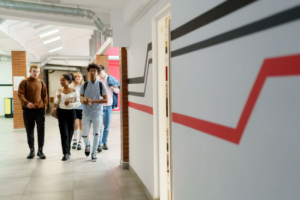
In spaces like school corridors, care homes, and retail environments where walls are regularly knocked, scraped, or cleaned with harsh products, that durability translates directly into lower maintenance costs and fewer replacement cycles over the lifetime of the building.
2. It Meets Commercial Fire Safety Standards
Fire safety compliance is non-negotiable in commercial construction and refurbishment. Many standard wallcoverings require additional treatments or coatings to meet fire regulations, and even then the performance can be inconsistent depending on the substrate and the paint used.
Fibreglass wallpaper is inherently non-combustible. The Glasstex range supplied by Eclipse Wallcoverings, for example, is approved to Class ‘O’ UK building regulations and Euroclass B-s1,d0 when finished with any good quality water-based paint. For architects and contractors working on healthcare facilities, hospitality venues, and public sector buildings, that level of certified fire performance removes a significant compliance burden from the specification process.
3. It Can Be Repainted Multiple Times
One of the most practically useful qualities of fibreglass wallpaper in a commercial context is that it bonds permanently to the wall surface and becomes part of the substrate itself. Once installed and painted, it can be repainted repeatedly using any water-based paint without needing to be removed and replaced.
In practice, this changes the economics of commercial redecoration entirely. Instead of stripping walls back to bare plaster and starting again every time a space needs refreshing, building managers can simply repaint over the existing wallcovering. For hotels, offices, and public buildings that rebrand or refresh their interiors every few years, the cost savings across multiple decoration cycles are substantial.
4. It Covers Existing Wall Defects
Older commercial buildings often have walls that tell the story of every repair, renovation, and settling movement they’ve been through. Hairline cracks, uneven surfaces, and patched sections can be difficult and expensive to bring back to a smooth, paint-ready finish using conventional methods.
Fibreglass wallpaper bridges these imperfections rather than simply covering them cosmetically. Because the woven glass fibre structure reinforces the wall surface, it actively helps prevent existing cracks from reopening and new ones from forming. For refurbishment contractors working in older stock, this makes fibreglass wallpaper a practical solution that reduces the preparation work required before decoration can begin.
5. It Supports Healthier Indoor Environments
Commercial buildings are increasingly assessed not just on energy performance but on indoor environmental quality. Moisture management plays a significant role in that. Walls that trap moisture behind impermeable surfaces create conditions where mould and damp can develop, particularly in kitchens, changing rooms, and any space with variable temperature or humidity.
Fibreglass wallpaper has an open-pore structure that allows natural moisture vapour diffusion through the wall. The inorganic glass fibre material doesn’t absorb moisture or support microbial growth in the way that paper-based wallcoverings can. For environments like healthcare settings, leisure facilities, and commercial kitchens where air quality and hygiene standards matter, this breathability is a meaningful technical advantage rather than a minor feature.
6. It Has a Lower Environmental Impact Than Alternatives
Sustainability is now a live consideration in most commercial specification decisions, whether that’s driven by client requirements, planning conditions, or procurement policy. Fibreglass wallpaper compares favourably with many alternatives on this front. It is produced without PVC, formaldehyde, or other compounds typically associated with indoor air quality concerns, and because it lasts significantly longer than standard wallcoverings, the resource consumption per decade of use is lower.
The lightest fibreglass woven textile wallcoverings on the market use fewer raw materials and require less energy in production and transport. For projects working toward sustainability targets or green building certifications, specifying a wallcovering with verifiable environmental credentials is increasingly a requirement rather than a preference.
The Bigger Picture
What commercial decision-makers are responding to with fibreglass wallpaper is a straightforward value proposition: a wall finish that performs reliably over time, meets safety and sustainability requirements, and costs less to maintain than the alternatives. For spaces that need to look good and function well under consistent pressure, that combination is proving difficult to argue against.