Senegal and Mauritania are home to the Greater Tortue Ahmeyin (GTA) Project, one of the most significant and deepest offshore gas developments in Africa, which is set to vastly increase the domestic energy and revenue for both countries for many years to come. The development is part of a cross-border project delivered by BP alongside its partners Kosmos Energy, Société Mauritanienne des Hydrocarbures (SMH), and PETROSEN. With the development signalling such a vital development for both countries, the GTA Project was granted the status of National Project of Strategic Importance by the Presidents of Mauritania and Senegal. This status highlights just how valuable the development remains for the countries and the significant growth of Liquefied Natural Gas (LNG) in Africa.
Check out the article in the magazine below:
BP entered into Mauritania and Senegal in 2017, following the discovery of a significant gas field that straddled the maritime border between the two countries. This gas field quickly became the home of two offshore development blocks: St. Louis Offshore Profond and Cayar Offshore Profond. The blocks are major offshore development and exploration hubs, which today are significant anchors of the GTA LNG project. Phase 1 of the GTA development involved an innovative multi-billion-dollar investment project spanning the development of an ultra-deep subsea system with four gas production wells, a Floating Production, Storage and Offloading (FPSO) vessel, and a Floating Liquified Natural Gas (FLNG) Facility. The initial Final Investment Decision (FID) came in 2018, following an agreement between the Mauritanian and Senegalese governments and the development partners to commence the multi-phase project set on delivering the basin as a world-class gas province and major LNG hub.
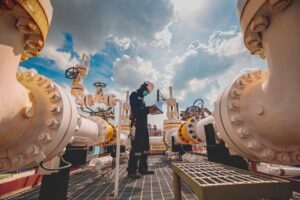
Once gas is produced from the subsea production system it is then processed in the mid-water by the FPSO, where water and impurities are removed, producing gas ready for liquefaction. The gas from the FPSO is then sent along a 35km pipeline to an inshore hub and terminal, which includes a Floating Liquefied Natural Gas (FLNG) facility. Here, the gas is cooled, allowing it to transform into a liquid, enabling easier storage and long-distance transportation of the LNG to markets. The development of LNG at the GTA Project is significant, as the exploration field is estimated to contain more than 19 trillion cubic feet (tcf) of potentially recoverable gas resources and so will be a key pillar of Senegal and Mauritania’s long term LNG development. Plus, GTA is just one part of the wider 13,500km2 acreage held by BP and its partners in Mauritania and Senegal, which itself is estimated to hold between 50-100tcf of gas resources potential, thus making the whole development one of the most significant gas projects in Africa.
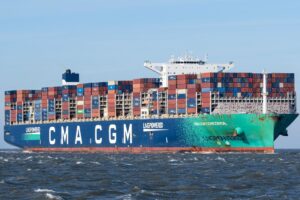
LNG produced from the GTA Project will then be exported through LNG carriers, which will berth at the Hub Terminal before transferring the LNG to further carriers for export. However, some of the LNG will be allocated to Senegal and Mauritania to help meet growing energy demands in the host countries and support their continued energy security and development. Once fully commissioned, the GTA Phase 1 development is expected to produce around 2.3 million tonnes of LNG a year, delivering vital resources for both countries, supporting local energy networks, whilst solidifying the countries and the development as a hub for global LNG development.
In January 2025, BP announced that the GTA Project had achieved first gas flow from the development to its FPSO vessel. This achievement of first gas flow from the development is a significant milestone for the project, marking a vital first step towards delivering the vital potential of the GTA project’s resources to market. Following the first flow in January, BP then announced in April 2025 that it had completed the loading of its first cargo from the GTA LNG project for shipment. The announcement outlined that BP had safely loaded the first cargo of LNG for export from the development, highlighting the GTA project as the third upstream major start-up of the year for BP. This is significant for BP because it is aiming to grow its upstream oil and gas business, with the company expected to deliver 10 project start-ups by 2027, of which GTA is the first.
Speaking on the announcement in April 2025, Gordon Birrell, Executive Vice President of Production and Operations at BP, outlined, “This first cargo from Mauritania and Senegal makes a significant new supply for global energy markets. Starting exports from GTA Phase 1 is an important step for BP and our oil and gas business as we celebrate the creation of a new production hub within our global portfolio.” Adding to this, Dave Campbell, Senior Vice President for BP Mauritania and Senegal, highlighted, “This is a very proud day for Mauritania and Senegal. Throughout the development of this project, we have built strong relationships with the project’s host governments, local communities and our partners, and we look forward to strengthening these in years to come as we continue ongoing operations.”
Both Campbell and Birrell’s comments here highlight the valuable role that the GTA development plays in Mauritania and Senegal’s development, not just economically for global energy markets and solidifying its place as a key production hub within the company’s global portfolio. However, it is a development that also continues to support the communities in which it operates to deliver lasting positive change, in line with its ongoing development. In fact, this focus on local development was further exemplified at the end of 2025, with the installation of an artificial reef village off the coast of Senegal.
In December 2025, BP installed an artificial reef consisting of 10 clusters of reef structure made up of pioneering reef cubes and pyramid structures. The reef, located 4km off the coast of St. Louis, was delivered from an estimated 3.2 billion CFA investment. The structure features multiple nature-inclusive design additions to enhance marine biodiversity and support sustainable fishing practices and local fishing communities. The installation was delivered in line with community engagement, engineering feasibility studies and environmental services. BP’s partners, along with local fishermen, authorities, and regulators were pivotal to the development, alongside the Marine Research Association. Collectively, these bodies ensured that the design and placement of the artificial reefs met community needs, international standards and ecological conditions.
Speaking on the artificial reef installation, Massaer Cisse, Vice President and Head of Country in Senegal for BP, outlined, “BP is committed to supporting the communities in which we operate. The artificial reef project is a testament to our dedication to biodiversity, sustainable livelihoods, and long-term community value. We are proud to collaborate with our partners and the people of Saint-Louis to deliver this impactful initiative”. Cisse’s comments highlight the ongoing role BP and its partners are continuing to play to deliver the GTA project alongside local communities. Thus, as the GTA continues to be developed, BP and its partners cotninue to focus on local development as part of their multi-million-dollar social investment program, reflecting its commitment to environmental stewardship and community development in line with its LNG energy delivery projects.
As the GTA Project looks towards the future, Phase 2 of the project is currently in development talks. In February 2024, BP and partners in the GTA project confirmed that the concept for the second phase of the GTA LNG project had been outlined, and it is moving towards the next stage of evaluation. A key aspect of the GTA Phase 2 expansion is expected to see an increase in the development’s total capacity to between 2.5 and 3 million tonnes per year. To facilitate this, the Phae 2 concept design will include new wells and subsea equipment, which will be integrated and expand upon the existing GTA infrastructure.
Speaking on the proposed Phase 2 development, Gordon Birrell said, “We aim to build on our strong collaboration with our partners, and the Governments of Mauritania and Senegal, to further develop a long-term, successful energy hub in West Africa. GTA continues to underpin our strategy to develop the most resilient hydrocarbons to help provide energy security today.” Birrell’s comments exemplify the long-term strategy of the GTA development, which is set to enhance LNG development in Africa and help deliver Mauritania and Senegal as leading LNG producers.
Overall, the Greater Tortue Ahmeyim Project is a vital LNG exploration and development project that is enhancing the domestic energy and revenue of both Senegal and Mauritania through vital LNG resource development. As we have seen across Phase 1 of the development, the development is already set to deliver significant resources for the two countries and the local communities in the process. We look forward to seeing how the next phase of the development will progress as BP, along with its partners, looks set to advance the innovative and multi-billion-dollar investment project and cement the project’s place as a hub for LNG development in Africa.