
Turkey is a thriving hub for trade, connecting businesses across the country with markets spanning Europe, the Middle East and Asia. Every year, the country’s cargo trade contributes significantly to its economic development, with key industries such as vehicles and automotive parts, machinery, refined petroleum, textiles and jewellery making up its export markets. These products serve global markets, with a particular focus on Germany, the United Kingdom, the United States, Iraq and Italy. To support such a diverse export market, global shipping and logistics company Maersk offers comprehensive logistics services across the country, combining ocean transport with inland services, air freight and contract logistics. Now, more than 30 years since Maersk began operation in Turkey, the company plays a vital role in supporting its long-term economic success and enhancing its role in global supply chains in the process.
Check out the article in the magazine below:
Maersk has been operating in Turkey since 1993, offering vital shipping, logistics, warehousing and customs services that serve the country’s key import and export markets. Across Maersk’s operations in Turkey, the company offers regular services from 7 key Turkish ports, which are then connected via its vast ocean fleet to shipping lines and markets around the world. Some of the most significant ports and port areas covered by Maersk’s operations are the Port of Ambarli, the Mersin International Port, the Aliağa Port Complex, and the port and industrial logistics hub of İzmit Körfezi. Across these ports and cargo hubs, Maersk is committed to enhancing global trade, solidifying each port and port area as vital nodes in Maersk’s global shipping network.
One of the most significant ports in Turkey served by Maersk is the Ambarli Port, which is the largest container port complex in the country. The port, located 34km west of Istanbul’s centre, is a modern facility serving as a critical entryway for maritime trade into one of the country’s major cities. Having been initially developed to enhance Turkey’s logistics and trade capabilities, the port has grown significantly, and it is now a leading container shipping hub playing a pivotal role along the region’s supply chains. The port connects with global trade routes which reach Europe, Asia and the Middle East, and so, sees more than 1.5 million twenty-equivalent units (TEUs) passing through the port every year.
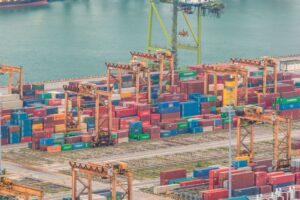
A critical component of the Port of Ambarli is its dedicated container terminal, which is equipped with automated cranes, as well as advanced cargo handling and storage facilities to support seamless operations that keep cargo moving seamlessly in and out of the country. Furthermore, the port even benefits from a Free Trade Zone status, and so it is a pivotal hub for supply chain movement, thanks to its tax incentives for importers. Beyond the port, cargo can easily be moved across major highways and railways that connect directly to the port, supporting efficient movement of cargo across the country.
For Maersk, the Port of Ambarli serves as a key hub for both Black Sea and Aegean feeder services, connecting global routes with international shipping lines through regular services to and from the port. In fact, one of the most significant parts of the port is the Marport Container Terminal, which is located within the Port of Ambarli complex and comprises a Main and West terminal. These terminals are responsible for handling almost half of all the container volume moving throughout the Ambarli region. Therefore, for Maersk, the Port of Ambarli presents a vital hub with the necessary supporting infrastructure to support global logistics operations, to ensure its customers benefit from efficient, reliable and safe cargo operations across the port.
The Mersin International Port is another key hub for Turkey’s global trade, located strategically along major maritime routes, whilst being adjacent to a diversified and fast-growing hinterland. The Port is one of the main container ports serving the Mediterranean Region, connecting key shipping routes travelling across the Mediterranean with Western Europe, the Far East, North America and North Africa. Therefore, the port provides vital access to markets in Turkey and across the Eastern Mediterranean region. Maersk has a strong and active operational presence at the Mersin International Port, offering comprehensive ocean transport, inland haulage, and specialised services for both dry and reefer cargo arriving at the port. Thus, the port continues to play a leading role in global supply chains, and so Maersk utilises it as a vital hub connecting customers across the region with global shipping lines traversing the globe.
In İzmir, the Port of İzmir (Port of Alsancak) and Aliağa Port Complex play key roles in the country’s overall cargo operations, delivering İzmir as a major industrial maritime hub, focused on oil, bulk cargo, and chemical handling. Maersk operations in İzmir centre on the Nemport Terminal in Aliağa, which is designed to handle a range of container services traversing the Mediterranean region. This focus comes following Maersk’s announcement in January 2026 that it would no longer be calling at the SOCAR Complex in Aliağa and would instead call at the Nemport Terminal along its SLC Aegean Sea Service. Nemport is the first private container port in the Aegean region and is located in Aliağa. The port operates as a key gateway for trade for the region, with the port seeing an ever-increasing container handling volume. The shift from the SOCAR Complex to Namport highlights Maersk’s commitment to improving reliability for its customers by enabling better supply chain planning for its customers across the network.
Much like Aliağa, the Port of İzmit Körfezi is a critical industrial and logistics hub serving Turkey, spanning more than 35 specialised terminals handling container, liquid bulk and general cargo. Key facilities within the hub include the Yilport Gebze/Körfez, DP World Yarınca and Evyap Port Terminals. With a wealth of key terminals across the area, İzmit holds a significant role in the shipping industry of Turkey, serving as a logistics hub primed to connect with shipping lines across the Mediterranean, and so it serves as a critical transhipment hub. Here, Maersk serves the maritime hub with its logistics and container services centring on the terminals.
As we can see, Turkey is home to a plethora of key ports which support its shipping and logistics industry and help it solidify its place as a key global hub for cargo operations. These operations are supported by Maersk’s extensive shipping and logistics services, leveraging each port and district’s transport connections, both across inland and global shipping lines. Furthermore, thanks to these ports and the vital services of Maersk, customers across Turkey can access global markets, whilst global markets can reach key destinations within Turkey. With such a diverse array of commodities seen across Turkey’s shipping network, each shipment requires its own set of risk management and insurance policies. For this, Maersk offers a hybrid insurance model across its global networks, utilising both its own insurance company and partnerships with global insurance providers to ensure that all cargo is protected from origin to destination.
For Maersk, it understands that cargo can get damaged at any step of its journey on the way to its destination, and so it works to ensure that its customers’ cargo is supported by the best insurance solutions on the market. Its insurance policies cover a whole range of cargo types, taking into consideration their unique needs, to provide customers with peace of mind knowing their shipment is protected from warehouse to warehouse. Typical things covered by Maersk’s insurance policies are loss or damage during warehousing or during warehouse transit, often regardless of the transportation provider, as well as protection for natural catastrophes, General Average (GA), war risk, and strikes.
Beyond this, Maersk also has a ‘Value Protect’ cover, which adds an extended liability product on top of its insurance policies. Value Protect is a simple add-on product that extends the liability for terms of carriage to cover aspects that are not usually included in traditional insurance terms, and can include things such as delays and fire. This addition can be added to any customer’s contract or shipment, adding yet another layer of peace of mind. Both Maersk’s insurance policies and Value Protect help ensure customers know that their shipments are safe and protected with Maersk, who are committed to keeping cargo moving and supply chains supported all across the world.
Across Maersk’s operations in Turkey, we can see how the company connects the region’s vital ports and port complexes with its global network to enhance global connectivity and support Turkish businesses in reaching international markets every day. Supported by Maersk’s breadth of experience in the global shipping sector, customers across Turkey and the wider region rely on Maersk to support their supply chains with leading shipping and logistics solutions, backed by reliable insurance policies.


Add Comment