

Home to diverse industries and a thriving economy, the United States of America plays a key role in global trade. Every day, ports across the US handle a wide range of cargo entering and exiting the country, serving customers on both a local and international scale. Key imports include manufactured goods such as machinery, electronics, vehicles and pharmaceuticals, whilst exports span oil and gas, aircraft and parts, agricultural products, chemicals and machinery. Thus, the US has many significant trade links across the world, including links with Mexico, China and Canada. To facilitate such vital trade connections, key shipping companies, such as A.P. Møller – Mærsk (Maersk), provide a well-connected, agile and reliable logistics network to enhance the US’s global trade.
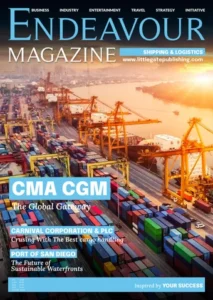
Check out the article in the magazine below:
Maersk is a heavyweight in the global shipping industry, with operations spanning 130 countries worldwide. With such a wealth of experience, Maersk is primed to facilitate key trade both within the US and across the world. It achieves this through full inland services, which ensure that cargo can move smoothly across the region and onto key trading markets through Maersk’s integrated transportation routes. Today, Maersk offers regular shipping services across the entire US coastline, including major gateway ports such as the Port of Los Angeles, Port Long Beach, Port Houston and Port New York. To facilitate its shipping network, Maersk has key offices spread across the country, which are committed to ensuring that both ocean transport and inland services deliver seamless connections to get cargo from origin to end market.
One of the most notable things about the US is its vital road, rail, and waterway networks that help make logistics across the country so effective. These networks ensure that once cargo arrives at the various ports along the country’s coastline, it can then be moved across the country’s interstate and rail networks, or along the country’s waterways systems to reach end markets within the nation. This inland service is one of the ways that Maersk is able to support the movement of cargo from origin to destination. From the moment cargo arrives in the country, Maersk is committed to providing complete, seamless, and fully integrated shipping solutions across all transportation networks on both a national and international scale, to support efficient supply chains for its American customers and those seeking to enter the US market.
One of the key ports in the US is the Port of Houston, which is regarded as one of the world’s largest ports serving Texas. The port is home to 8 public facilities, which include the area’s largest breakbulk facility and two of the most efficient container terminals in the nation. Thus, the port has long served as a strategic hub for free-flowing commerce throughout the region, supporting both local and international trade. Alongside the Port of Houston, Maersk also serves key Texas ports such as the Port of Corpus Christi, which is a major energy hub for the United States. Here, Maersk provides key logistics and warehousing operations to help support the delivery of both liquid bulk and general cargo from the port and across the country.
The largest port in the US is the Port of Los Angeles, which provides essential cargo operations for the nation and handles the majority of the country’s trans-Pacific trade. Therefore, as the busiest seaport in the Western Hemisphere, it is vital to the overall trade and shipping development of the US, making it a crucial port for Maersk’s global network. Maersk operates across the port through its subsidiary company, APM Terminals, which handles the large volumes of cargo that move through the port every day. APM Terminals is responsible for the operations of the Pier 400 Terminal, which is the largest container terminal in the Western Hemisphere. The Terminal is a key facility within Maersk’s North American network, and so it supports a more well-connected trade network across the country.
Another premier US gateway port for trans-Pacific trade is the Port of Long Beach. The port can welcome today’s largest vessels, serving 175 shipping lines that connect with 217 seaports across the world. In 2024 alone, the port handled more than 9.6 million container units, achieving the busiest year in its history. The Port’s infrastructure includes Total Terminals International (TTI) on Pier T, which is one of the largest terminals in North America. The terminal can handle 3 ultra-large container vessels, which are met with 14 ship-to-shore cranes simultaneously. With one of the best on-dock rail facilities on the West Coast of America, the Port and its TTI’s infrastructure is well-suited for inland interconnectivity to keep cargo moving from the port across the state and into the country. Today, Maersk’s operations arrive at the Port of Long Beach along vital vessel call routes, helping to bring greater fluidity for customers’ supply chains utilising the port’s reliable infrastructure.
To help enhance Maersk’s ocean and inland transportation services across the US, the company also delivers vital warehousing and distribution services across the country. Maersk has an extensive network of warehouses and distribution centres in the US, which are designed to reduce complexity and speed up cargo shipments. To achieve this in North America, Maersk acquired Performance Team, a US-based warehousing and distribution company. Performance Team support Maersk in providing integrated container logistics services, supported by end-to-end supply chain solutions.
Across its warehousing services, Maersk delivers storage, fulfilment, distribution, and inland transportation needs, which enhance regional operations efficiency and deliver customer satisfaction. Customers continue to choose Maersk’s warehousing and distribution services as they are facilitated with integrated IT systems for enhanced efficiency and visibility of cargo movement. They also ensure that warehouses are strategically located to serve customers’ needs, to help expedite deliveries and reduce customers’ capital expenditure. Plus, with Maersk’s warehousing services integrated into its global shipping network, customers can benefit from Maersk all in one service that combines ocean, air and road transportation services with its warehousing and distribution network, for seamless end-to-end solutions that are tailored to its customers’ business needs.
For customers across the United States of America, Maersk is a key shipping partner that utilises the country’s vast and vital gateway ports to deliver integrated global shipping operations that support cargo delivery across every step of its journey. From vital port operations at key shipping hubs along the US coastline to inland shipping and warehousing solutions, Maersk is committed to being a key shipping partner for its customers to keep supply chains moving, supported by the company’s personalised shipping solutions tailored to each customer’s specific needs.